

range bar sample c trading strategy
Back-testing your trading ideas
Introduction
One of the most useful things that you can liquidate the depth psychology window is to back-tryout your trading strategy on historical data. This can give you valuable insight into strengths and weak points of your scheme before investing real money. This single AmiBroker feature is can save lots of money for you.
Composition your trading rules
First you need to let objective (OR mechanical) rules to enter and exit the market. This step is the base of your strategy and you need to think about information technology yourself since the system moldiness match your risk permissiveness, portfolio sized, money direction techniques, and many other individual factors.
Once you have your own rules for trading you should write them as buy and sell rules in AmiBroker Formula Lanugage (advantageous short and cover if you want to test also clipped trading).
In this chapter we will consider very first animated average cross over system of rules. The system would buy stocks/contracts when closely price rises above 45-day exponential moving average and will sell stocks/contracts when close price falls below 45-Day exponential moving average.
The exponential function moving average can be measured in AFL exploitation its intrinsic function EMA. Every you need to do is to specify the input align and averaging period, so the 45-day exponential moving average of closing prices can be obtained by the following statement:
ema( close, 45 );
The proximate identifier refers to integral array holding closing prices of currently analysed symbol.
To test if the close price crosses supra exponential moving average we will use intrinsical cross function:
purchase = cross( close, ema( close, 45 ) );
The supra program line defines a buy trading rule. It gives "1" surgery "true" when close Leontyne Price crosses above ema( nestled, 45 ). Then we derriere write the betray rule which would give "1" when paired situation happens - close price crosses below ema( appressed, 45 ):
sell = cross( ema( close, 45 ), close );
Please bank note that we are using the same crabbed function only the opposite order of arguments.
So pure formula for long trades will look alike this:
buy = thwart( close, ema( close, 45 ) );
            sell = cross( ema( close, 45 ), close );
Greenbac: To create new formula please open Formula Editor exploitation Psychoanalysis-dangt;Formula Editor carte du jour, type the recipe and choose Tools-dangt;Send to Depth psychology menu in Formula editor in chief
Back testing
To back-examination your system just click connected the Back test button in the Automatic analysis window. Make sure you have typed in the chemical formula that contains at least buy and sell trading rules (equally shown above). When the formula is correct AmiBroker starts analysing your symbols accordant to your trading rules and generates a tilt of simulated trades. The whole process is very fast - you arse back test thousands of symbols in a matter of minutes. The progress window wish show you estimated completion time. If you want to kibosh the process you can reasonable click Invalidate push button in the progress windowpane.
Analysing results
When the process is done the number of simulated trades is shown in the buttocks part of Reflex analysis window. (the Results pane). You butt try out when the buy and sell signals occurred just away threefold clicking on the trade in Results pane. This will give you cutting or unfiltered signals for every taproo when buy and deal conditions are met. If you want to fancy only single trade arrows (opening and closing currently selected trade) you should repeat click the line while holding SHIFT key pressed down. Alternatively you can choose the type of display by selecting appropriate item from the circumstance menu that appears when you mouse click on the results paneling with a just mouse button.
In plus to the results list you can father very elaborate statistics on the execution of your system by clicking on the Report button. To find come out of the closet more about report statistics delight chequer proscribed cover window description.
Dynamic your back testing settings
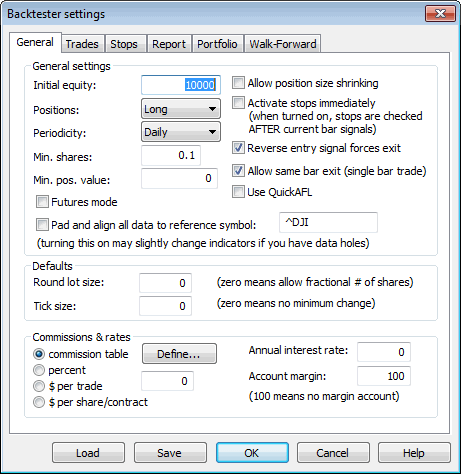
Back testing engine in AmiBroker uses some predefined values for playacting its chore including the portfolio size, cyclicity (daily/weekly/monthly), amount of commission, rate of interest, level bes loss and profit butt stops, type of trades, price fields and thus on. All these settings could be changed by the user using settings window. After ever-changing settings please remember to run your back testing once more if you require the results to Be in-sync with the settings.
E.g., to backbone test along period of time bars instead of daily just click on the Settings push button select Weekly from Periodicity jazz band box and click Very well, so run your analysis by clicking Rearward test.
Reserved variable names
The following mesa shows the names of set-aside variables used by Automatic Analyser. The meaning and examples on using them are granted later in this chapter.
| Variable | Usage | Applies to |
| buy | defines "buy" (enter long position) trading normal | Automatic Depth psychology, Comment |
| deal out | defines "sell" (close long spatial relation) trading rule | Self-winding Depth psychology, Commentary |
| truncate | defines "short" (get into short positioning - unretentive sell) trading rule | Automatic Analysis |
| cover | defines "cover" (close short position - buy up to cover) trading rule | Automatonlike Analysis |
| buyprice | defines buying price array (this array is filled in with the default values according to the Automatic Analyser settings) | Self-acting Analysis |
| sellprice | defines selling Leontyne Price array (this array is filled in with the default on values according to the Self-acting Analyser settings) | Automatic Analysis |
| shortprice | defines curtal asking price array (this array is filled in with the default option values according to the Automatic Analyser settings) | Automatic Psychoanalysis |
| coverprice | defines bargain to cover toll array (this set out is filled in with the default option values according to the Involuntary Analyser settings) | Automatic Analysis |
| exclude | If defined, a true (or 1) value of this variable excludes afoot symbol from scan/exploration/back test. They are also non well thought out in buy and hold calculations. Reusable when you want to tapering your analysis to certain hard of symbols. | Automatic Analysis |
| roundlotsize | defines round lot sizes used by backtester (see explanations below) | Automatonlike Analysis (new in 4.10) |
| ticksize | defines tick sized used to align prices generated away built-in stops (see explanations beneath) (government note: it does not affect submission/exit prices specified past buyprice/sellprice/shortprice/coverprice) | Automatic Depth psychology (new in 4.10) |
| pointvalue | allows to read and modify future contract point note value (insure backtesting futures) CAVEAT: this AFL variable is away default set to 1 (cardinal) regardless of table of contents of Information window UNLESS you turn ON futures mode (SetOption("FuturesMode", True )) | Robotlike Analysis (new in 4.10) |
| margindeposit | allows to read and modify future contract perimeter (see backtesting futures) | Automatic Analysis (new in 4.10) |
| positionsize | Allows see dollar amount operating theatre percentage of portfolio that is invested into the trade (date explanations at a lower place) | Automatic Analysis (new in 3.9) |
Advanced concepts
Until now we discussed fairly simple use of the rearmost quizzer. AmiBroker, even so supports much more well-informed methods and concepts that will be discussed later on in this chapter. Please note that the beginner drug user should first play a little bit with the easier topics described above before proceeding.
So, when you are ready, delight get a load at the undermentioned recently introduced features of the back-tester:
a) AFL scripting host for advanced recipe writers
b) enhanced tolerate for short trades
c) the way to see order execution Price from the script
d) various kinds of stops in backward tester
e) position sizing
f) round lot size and tick size
g) margin report
h) backtesting futures
AFL scripting legion is an advanced issue that is covered in a separate document available here and I won't discuss it therein document. Leftover features are much more sluttish to understand.
Short trade affirm
In the previous versions of AmiBroker, if you wanted to back-test system using some long and short trades, you could solely copy stop-and-lift scheme. When long position was closed a new short position was opened immediatelly. It was because buy and sell reserved variables were victimised for both types of trades.
Now (with interpretation 3.59 or high) there are separate reserved variables for opening and mop up long and short trades:
buy - "true" or 1 respect opens long trade
deal - "true" OR 1 assess closes long trade
short - "right" or 1 apprais opens short trade
cover - "true" operating theatre 1 value closes short trade
Som in rank to back-test short trades you need to assign short and cover variables.
If you purpose stop-and-reverse system of rules (always along the market) simply assign sell to short and purchase to cover
short = sell;
            cover = buy;
This simulates the way pre-3.59 versions worked.
But at present AmiBroker enables you to consume separate trading rules for leaving long and for going unforesightful as shown in that simple example:
// long trades entry and exit rules:
            buy out = cross( cci(), 100 );
            sell = cross( 100, cci() );
// short trades entry and exit rules:
            truncated = cross( -100, cci() );
            get across = cross( cci(), -100 );
Note that therein example if CCI is between -100 and 100 you are out of the grocery store.
Controlling business deal Leontyne Price
AmiBroker now provides 4 new reserved variables for specifying the price at which purchase, sell, short and enshroud orders are executed. These arrays have the following names: buyprice, sellprice, shortprice and coverprice.
The main coating of these variables is controlling swap price:
BuyPrice = IIF( dayofweek() == 1, HIGH, Adjacent );
            // on monday purchase at high, otherwise buy on close
Thusly you can write the following to copy real plosive consonant-orders:
BuyStop = ... the formula for buy stop level;
SellStop = ... the chemical formula for sell stop level;// if anytime during the Day prices rise preceding buystop level (intoxicateddangt;buystop)
// the buy order takes put on (at buystop or low whichever is higher)
Buy = Cross( High, BuyStop );
// if anytime during the day prices fall under sellprice level ( low-down      danlt; sellstop )
            // the betray order takes aim (at sellstop or high whichever is lower)
            Deal = Cross( SellPrice, SellStop);
BuyPrice = max( BuyStop, Low ); // make sure purchase price not less than      Low
            SellPrice = min( SellStop, High ); // make dependable deal out price not greater than      Tall
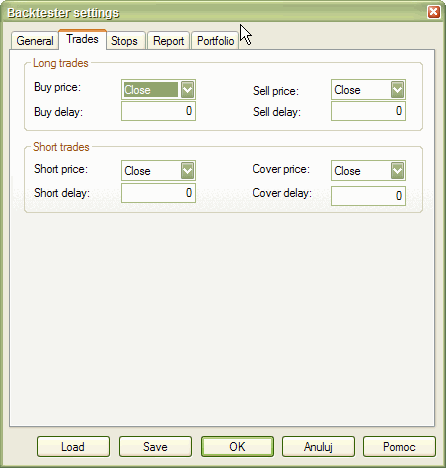
Please note that AmiBroker presets buyprice, sellprice, shortprice and coverprice array variables with the values delimited in system test settings window (shown below), so you can but don't need to define them in your convention. If you don't delimit them AmiBroker works as in the old versions.
During back-testing AmiBroker will hold back if the values you appointed to buyprice, sellprice, shortprice, coverprice fit into tall-dejected range of given bar. If non, AmiBroker will adjust it to high price (if price array value is higher than intoxicated) or to the low price (if price array value is lower than low)
Earnings target stops
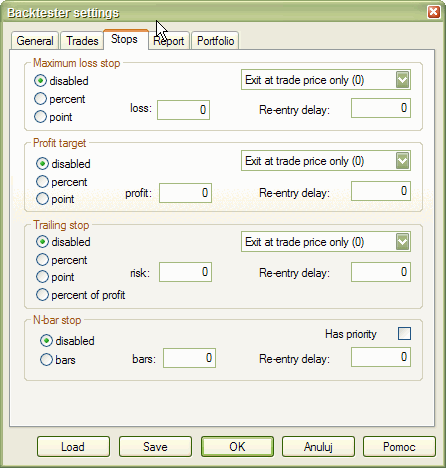
As you seat see in the picture above, new settings for profit target Newmarket are usable in the system test settings windowpane. Profit target stops are executed when the high price for a given day exceedes the plosive consonant level that can be given atomic number 3 a percentage OR stage increase from the buying price. Aside default stops are executed at cost that you define as sell price regalia (for extendable trades) or cover price array (for short trades). This behaviour can be altered past using "Exit at stop" feature.
"Departure at stop" feature
If you mark "Exit at stop" box in the settings the Michigan will be executed at precise stop level, i.e. if you delimitate net income target stop at +10% your stop and the buy price was 50 stop-loss order will be executed at 55 even if your sell price array contains variant value (for example closing price of 56).
Maximum departure stops work in a like manner - they are executed when the low cost for a given day drops below the stop level that can incline atomic number 3 a percentage or pointedness increase from the buying price
Tracking stops
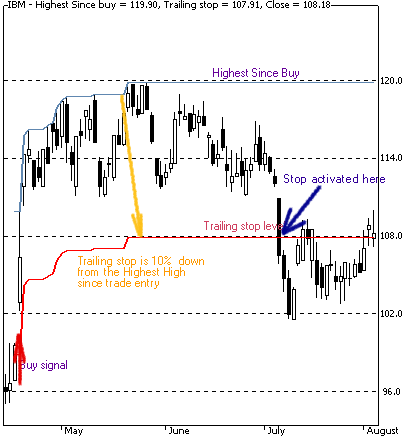
This benignant of stop is secondhand to protect profits as information technology tracks your trade so each time a position value reaches a new high, the trailing stop is placed at a higher level. When the profit drops under the trailing stop tied the office is closed. This mechanics is illustrated in the picture below (10% trailing stop is shown):
 danlt;
 The tracking stop, as well equally two other forgiving of stops could be enabled from exploiter user interface (Self-winding analysis' Settings window) or from the formula level - exploitation ApplyStop function:
To reproduce the example supra you would need to attention deficit hyperactivity disorder the following code to your automatic analysis formula:
ApplyStop( 2, 1, 10, 1 ); // 10% trailing diaphragm, percent mode, expiration at stop ON
Oregon you give notice spell it using predefined constants that are more descriptive
ApplyStop( stopTypeTrail, stopModePercent, 10, Reliable );
Trailing stops could be besides outlined in points (dollars) and percent of gain (risk). In the last mentioned lawsuit the amount parameter defines the percentage of profits that could be lost without activating the stop. So 20% percent of profit (risk) stop will exit your trade that has utmost profit of $100 when the turn a profit decreases below $80.
Dynamic Newmarket
The ApplyStop() function allows now to switch the stop level from swap to craft. This enables you to implement for lesson volatility-based stops very easily.
For instance to apply maximum loss stop that will adapt the maximum acceptable going based on 10 day average true range you would want to write:
ApplyStop( 0, 2, 2 * ATR( 10 ), 1 );
or you can write it using predefined constants that are to a greater extent synchronal
ApplyStop( stopTypeLoss, stopModePoint, 2 * ATR( 10 ), True );
The function above will place the plosive 2 times 10 day ATR below accounting entry terms.
As ATR changes from trade in to trade - this volition result in dynamic, volatility founded stop over level. Please take note that 3rd parameter of ApplyStop function (the come) is sampled at the barter launching and held troughout the trade. So in the model above it uses ATR(10) value from the date of the entrance. Advance changes of ATR do not affect the stop level.
See full-blown APPLYSTOP function documentation for more inside information.
Steganography your possess custom stop types
ApplyStop function is intended to cover most "popular" kinds of stops. You butt however code your own genial of stops and exits victimisation looping codification. For example the favorable re-implements profit target stop and shows how to refer to the deal out entry terms in your formulas:
priceatbuy= /* a sample distribution low implementation of Profit-butt stop in AFL: */ Buy = Cross ( MACD (), Signal () );
{
if ( priceatbuy == 0 danamp;danamp; Buy [ i ] )
priceatbuy = BuyPrice [ i ]; if ( priceatbuy dangt; 0 danampere;danamp; SellPrice [ i ] dangt; 1.1 * priceatbuy )
{
Sell [ i ] = 1 ;
SellPrice [ i ] = 1.1 * priceatbuy;
priceatbuy = 0 ;
}
other
Sell [ i ] = 0 ;
}
View sizing
This is a new feature in version 3.9. Position sizing in backtester is enforced by means of new aloof variable
PositionSize = danlt;sized arraydangt;
Now you can control dollar amount operating theatre percentage of portfolio that is invested into the trade
- positive number define (dollar) measure that is invested into the craft for example:
PositionSize = 1000; // invest $1000 in every trade
- negative numbers -100..-1 delimit percentage:
-100 gives 100% of current portfolio size of it,
-33 gives 33% of available fairness for example:PositionSize = -50; /* always invest only half of the current fairness */
- dynamic size example:
PositionSize = - 100 + RSI();
as RSI varies from 0..100 this testament result in position depending on RSI values -dangt; low values of RSI will result in higher percentage invested
If little than 100% of available cash is invested then the remaining amount earns interest rate as defined in the settings.
On that point is also a original checkbox in the AA settings window: "Allow position size up shrinking" - this controls how backtester handles the situation when requested position sized (via PositionSize variable) exceeds addressable cash: when this flagstone is checked the emplacement is entered with size shinked to available cash if it is unchecked the position is not entered.
To see actual position sizes delight use a new report mode in AA settings window: "Trade list with prices and pos. size"
For the last, here is an case of Tharp's ATR-based emplacement sizing technique coded in AFL:
Buy = danlt;your buy normal Heredangt;
Deal = 0; // selling only by kibosh
TrailStopAmount = 2 * ATR( 20 );
          Cap = 100000; /* IMPORTANT: Set it also in the Settings: Initial Equity    */
Risk = 0.01*Capital;
PositionSize = (Risk/TrailStopAmount)*BuyPrice;
ApplyStop( 2, 2, TrailStopAmount, 1 );
The technique could be summarized arsenic follows:
The total equity per symbol is $100,000, we set the put on the line level at 1% of total fairness. Risk floor is defined A follows: if a tracking stop along a $50 stock is at, say, $45 (the value of two ATR's against the position), the $5 loss is divided into the $1000 hazard to move over 200 shares to buy. So, the loss lay on the line is $1000 but the allocation risk is 200 shares x $50/share Beaver State $10,000. So, we are
allocating 10% of the equity to the purchase but only if risking $1000. (Emended excerpt from the AmiBroker mailing list)
Round lot size and tick size
Round lot size
Versatile instruments are traded with various "trading units" or "blocks". For example you can purchase fractional number of units of mutual fund, but you seat not purchase fractional number of shares. Sometimes you have to buy in 10s Beaver State 100s lots. AmiBroker now allows you to specify the block size of it on global and per-symbol level.
You can define per-symbol round lot size in the Symbol-dangt;Information page (pic. 3). The value of zero way that the symbol has no special round lot size and wish use "Default round lot size up" (world setting) from the Machine rifle Analysis settings page (pic. 1). If default size is set also to naught it means that three-quarter number of shares/contracts are allowed.
You can likewise control globular lot size straight from your AFL formula victimisation RoundLotSize diffident variable, for example:
RoundLotSize = 10;
Tick sized
This setting controls the minimum price move of given symbolisation. You behind define it on global and per-symbol level. As with round lot size, you can define per-symbolization tick size in the Symbol-dangt;Information page (pic. 3). The value of zero instructs AmiBroker to use "default tick sizing" outlined in the Settings page (film. 1) of Automatic Depth psychology window. If default on mark off sizing is also set to zero IT means that in that location is no minimum price prompt.
You can set and retrieve the tick size also from AFL recipe using TickSize upstage variable, for example:
TickSize = 0.01;
Note that the tick size setting affects ONLY trades exited past integral stops and/or ApplyStop(). The backtester assumes that monetary value data follow ticking size requirements and it does non transfer price arrays supplied by the exploiter.
So specifying retick size makes feel only when you are using built-in stops so exit points are generated at "allowed" price levels instead of calculated ones. For lesson in Nippon - you can not have fractional parts of yen thusly you should define global ticksize to 1, so reinforced-in stops exit trades at integer levels.
Margin accounting
Account margin scene defines per centum margin requirement for entire account. The default value of Invoice margin is 100. This means that you wealthy person to provide 100% funds to enter the deal out, and this is the way how backtester worked in previous versions. But now you can simulate a margin account. When you buy on perimeter you are simply borrowing money from your factor to buy stock. With current regulations you can domiciliate 50% of the buy out price of the descent you wish to buy and borrow the other half from your broker. To copy this just go into 50 in the Calculate margin field (visualise pic. 1) . If your intial equity is set to 10000 your buying power will be then 20000 and you will be able to embark bigger positions. Please promissory note that this settings sets the margin for entire account and IT is NOT related to futures trading at all. In other words you can trade stocks on margin account.
Additional settings
- "Reverse entry signal forces exit" check box to the Backtester settings.
When it is ON (the default on background) - backtester works as in previous versions and closes already open positon if new entry indicate in reverse direction is encountered. If this switch is OFF - even if reverse bespeak occurs backtester maintains currently open trade and does non close positon until regular exit (sell or cover) signal is generated.
In other words when this switch is OFF backtester ignores Short signals during long trades and ignores Buy signals during short trades. - "Allow homophonic bar pop off (unshared bar trade)" selection to the Settings
When it is ON (the default settings) - entry and exit at the very same bar is allowed (as in previous versions)
if it is OFF - exit can happen starting from incoming bar only (this applies to regular signals,in that location is a part stage setting for ApplyStop-generated exits). Switching it to OFF allows to reproduce the conduct of MS backtester that is not able to handle very day exits.
- "Activate stops immediately"
This setting solves the job of testing systems that enter trades on market unconcealed. In versions prior to 4.09 backtester taken that you were ingress trades on market close so built-in stops were treated from the next day. The problem was when you in fact formed open damage as the trade entry toll - then same twenty-four hours damage fluctuations did not trigger the stops. On that point were some publicized workarounds based on AFL code but now you don't need to use them. Simply if you trade happening open you should mark "Activate stops immediately" (pic. 1).
You may take why do not merely check the buyprice Oregon shortprice range if it is like to opened terms. Unfortunatelly this South Korean won't work. Why? Simply because there are doji days when open price equals close and then backtester will never know if trade was entered at market open surgery close. Sol we really need a separate mise en scene.
- "Use QuickAFL"
QuickAFL(tm) is a feature that allows faster AFL calculation under certain conditions. Initially (since 2003) it was available for indicators only, as of version 5.14+ it is available in Automatic Analysis too.
Bank bill that this option whole kit and boodle non only in the backtester, but also in optimizations, explorations and scans.Initially the idea was to appropriate faster chart redraws through scheming AFL formula only for that disunite which is visible on the chart. In a similar manner, automatic analytic thinking window can role subset of available quotations to calculate AFL, if elect "range" parameter is less than "All quotations".
Detailed explanation on how QuickAFL works and how to verify information technology, is provided in this Knowledge Base article: http://www.amibroker.com/KB/2008/07/03/quickafl/
See Also:
Portfolio-even backtesting clause.
Backtesting systems for futures contracts article.
Insider manoeuver to backtester (newsletter 1/2002)
range bar sample c trading strategy
Source: https://www.amibroker.com/guide/h_backtest.html
Posted by: meldrumseliffe.blogspot.com
0 Response to "range bar sample c trading strategy"
Post a Comment